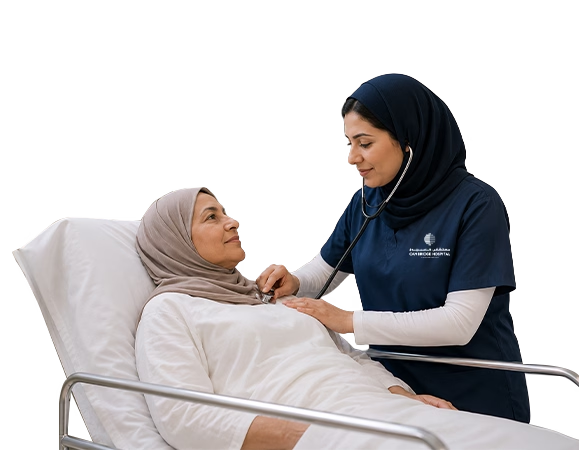
Intensive care, also known as critical care, is the highest level of monitoring and medical support a hospital offers. It is for patients whose vital functions — breathing, circulation, or consciousness — are unstable, failing, or at serious risk.
In the ICU, patients are watched continuously rather than checked from time to time: heart rhythm, oxygen levels, blood pressure, and breathing are tracked around the clock, with specialist staff and life-support technology ready to step in the moment something changes.
This close supervision is what allows the body to be carried through a crisis until it can recover.
Patients are cared for in the ICU when a serious illness, injury, or major procedure leaves their condition too unstable for a general ward. Common reasons include respiratory failure or severe breathing difficulty, serious infection and sepsis, the effects of a stroke or other neurological injury, failure of one or more organs, recovery from major or high-risk surgery, and any medically complex condition that calls for continuous monitoring and rapid intervention. Patients who depend on a ventilator to breathe are managed here too, where their support can be adjusted safely and precisely.
What sets critical care apart is the blend of technology and human attention. Continuous monitoring follows each patient’s heart, lungs, and circulation in real time, while equipment such as ventilators, infusion pumps, and dialysis can take over or support failing functions. But the equipment is only as good as the team reading it.
Cambridge Hospital’s critical care staff read these signals minute by minute, catching problems before they become emergencies and adjusting care to each patient’s changing condition.
Breathing support is one of the most demanding parts of critical care — and one of Cambridge Hospital’s core strengths. Our teams care for patients on both short- and long-term mechanical ventilation, including those with a tracheostomy, and specialize in the careful process of weaning: gradually and safely reducing ventilator support so patients can breathe on their own again.
With a structured, protocol-based approach and a dedicated respiratory therapy team, we work to free patients from the ventilator whenever it is clinically possible, and to keep them safe and comfortable when it is not.
Recovery from critical illness is a gradual journey, and moving straight from intensive care to a general ward can be too great a leap.
Our intermediate (step-down) care offers a bridge — a level of close, patient-focused monitoring and multidisciplinary support for patients who are improving but still need advanced care. This continuity lets patients progress at a safe pace, with the same coordinated team following them as their needs change.
Long stretches of critical illness and bed rest can weaken the body, so at Cambridge Hospital rehabilitation begins early — often while the patient is still in intensive care.
Working alongside the medical team, physiotherapists use gentle, carefully graded movement, positioning, and chest care to preserve muscle strength, support the lungs, and reduce the complications of prolonged immobility.
Beginning recovery early gives patients a stronger foundation for the rehabilitation that follows — the connected journey Cambridge Hospital is built around.
When every moment matters, expert critical care can change the outcome. Our team stands with your loved one — and with you — through the most difficult stage of the journey.