Long-term care is sustained support for people who need help with the activities of daily living — eating, dressing, bathing, and moving — alongside continuous medical and nursing care.
It suits those who are medically stable but not yet independent, and who do better in a safe, supervised setting where skilled staff are on hand around the clock.
Rather than a brief stay with a fixed end date, long-term care is an ongoing relationship that adapts as your needs change over time.
People arrive at long-term care for many reasons: chronic illness, physical or cognitive disability, the lasting effects of a stroke or serious injury, or a recovery that simply needs more time.
Some rely on a ventilator or other medical technology; others need help managing complex, overlapping conditions from day to day.
What they have in common is a need for consistent, expert care that a home setting alone cannot safely provide — delivered by people who know them well.
No two patients are alike, so no two care plans are either.
Our physicians, nurses, and therapists assess each person’s medical needs, abilities, and personal goals, then shape a plan around them — and review it as circumstances change.
Familiar caregivers and predictable daily routines create a sense of stability that counts for a great deal in long-term care, helping patients feel secure, understood, and at home.
At the core of long-term care is round-the-clock skilled nursing.
Our teams handle medications, wound and skin care, nutrition and feeding, continence care, and the monitoring of chronic conditions — spotting small problems before they turn serious.
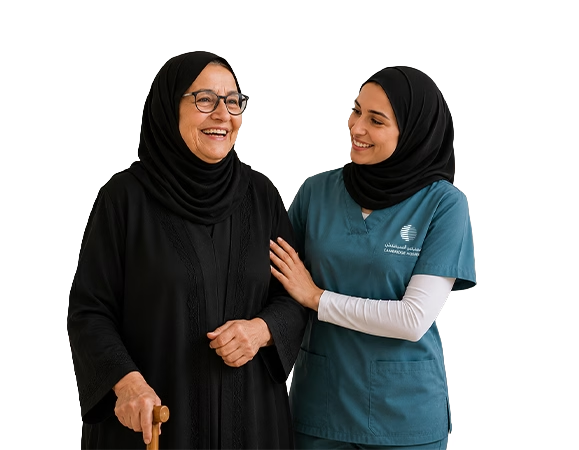
Patients get real, hands-on help with the everyday tasks that illness or disability has made difficult, always offered with patience and respect.
We have extensive experience caring for medically complex patients, including those who rely on a ventilator to breathe.
Our teams deliver safe, continuous respiratory and medical management for these patients and — wherever it is clinically possible — work steadily toward reducing that dependence over time.
Complex needs are met with calm, specialist expertise rather than repeated returns to hospital.
Long-term care and rehabilitation go hand in hand.
Physiotherapy, occupational therapy, and speech and language therapy are built into daily life to protect strength, mobility, communication, and independence — and to make the most of every gain.
Even when full recovery isn’t the aim, therapy helps patients stay as active, capable, and comfortable as possible for as long as possible.
When care is measured in months and years, dignity, comfort, and quality of life matter above all else.
We stand with you and your family at every step of the journey — for as long as you need us.