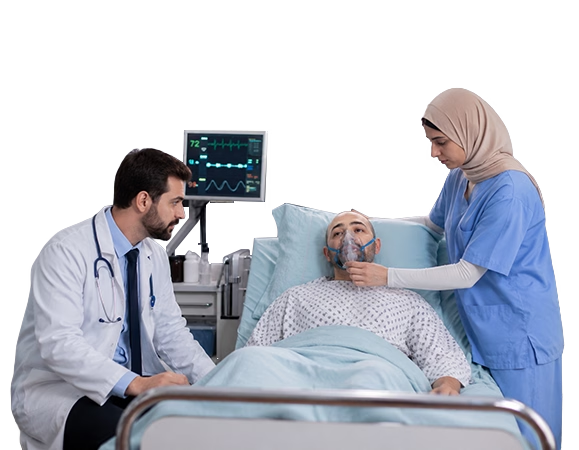
The Long‑Term Ventilated (LTV) Program provides continuous, specialized care for patients who rely on a ventilator for extended periods. It supports individuals who cannot breathe independently due to serious illness, neurological conditions, or complex respiratory failure.
The program is designed to make life safer and more manageable for ventilator‑dependent patients—whether they are in the hospital or transitioning back home.
The program’s goal is twofold: to provide optimal respiratory care, and to support families in managing complex, long-term health needs. Patients and families can expect:
- Airway clearance and respiratory therapies
- Inpatient and outpatient consultation
- Caregiver training in the safe use of ventilator equipment at home
- Support in coordinating the transition between home care and the intensive care unit
- Collaboration with surgical and medical specialists
- Consistent follow-up for patients receiving care at home
Throughout, rehabilitation plays a central role — helping patients regain the health and function affected by their respiratory condition, so they can work toward breathing independently as soon as possible.
The length of hospital stay varies for every patient, depending on how long they have required mechanical ventilation and the nature of their respiratory complications. Patients ventilated for shorter periods generally have shorter ICU stays, while long-term ventilation patients typically require longer, more intensive support.
Because longer ventilation is associated with a higher likelihood of readmission, our program emphasizes structured respiratory care and careful follow-up — and specific respiratory therapy protocols, along with spontaneous breathing trials (SBTs), can help reduce ventilator days and address ventilator dependence, eventually making a patient a candidate for weaning.
The aim of ventilator management is to help patients come off the ventilator as safely and as soon as possible. Weaning is the gradual process of liberating a patient from ventilator support, and the experience is different for every patient. Clinicians generally classify it by how long it takes:
- Simple weaning — successful on the first attempt, soon after the ventilator is removed
- Difficult weaning — achieved over a slightly longer period, typically within two to seven days of the initial assessment
- Prolonged weaning — for patients with more serious respiratory complications, taking more than seven days after the initial assessment
Each patient is carefully assessed against specific criteria before weaning is attempted, and the team proceeds only when a patient is ready — an approach that keeps reintubation rates relatively low. Where weaning isn’t yet successful, the team identifies and addresses the specific factors involved as part of a personalized care plan.
For patients with critical respiratory conditions, mechanical ventilation is a vital, often life-sustaining therapy — managing the impact of respiratory failure and supporting weakened respiratory muscles toward recovery.
Every patient’s journey is unique, and outcomes are always determined by the medical team in the context of the individual’s condition. For those on the path to recovery, the goal remains clear: to wean safely from ventilation wherever possible and regain independence.
Your recovery matters to us, and we are with you every step of the journey. Care at Cambridge Hospital is a connected journey across inpatient, outpatient, home, and in-school services — supporting every stage of recovery.